

A Complete Guide to Preserved Moss Wall Art

Moss art has become increasingly visible in homes, workplaces, wellness spaces and hospitality interiors, but if you are new to it, you may still be wondering what it actually is, whether it is alive, how long it lasts and how it differs from a living wall.

Preserved moss art sits somewhere between nature, craft and contemporary wall art. It uses real natural material, but unlike a houseplant or living wall it does not need watering, soil or ongoing maintenance. That combination is one of the reasons I was drawn to it as a material: it allows us to experience the texture, colour and emotional qualities of nature indoors without asking us to care for another living system.
This guide answers the questions I am most often asked about preserved moss art and biophilic decor, and explains what to consider if you are thinking about bringing a piece into your home or workspace.
What is preserved moss art?

Preserved moss art is made using real moss that has undergone a professional preservation process. During preservation, the plant's natural moisture is replaced with a non-toxic solution, commonly glycerin-based. This keeps the moss soft, flexible and visually fresh while stopping its natural growth cycle.
The result is natural material that retains much of its original texture and character but no longer behaves like a living plant. It does not grow, need soil or require light or watering.
Different makers work with different kinds of moss and lichen. In my own work I use a variety of preserved materials to build compositions with depth and a strong sense of place.
Is moss art alive?
No. Preserved moss is not alive, and this is an important distinction.
A living moss wall needs the right moisture, light and environmental conditions to survive. Preserved moss art has already been treated so that it can remain indoors without those requirements.
That means you should not water preserved moss. In fact, adding water can damage it. It should simply be kept indoors, away from direct sunlight, strong heat sources and constant blasts of air from vents.
How long does preserved moss art last?
There is no single expiry date because longevity depends on the quality of the preserved material and the environment in which the artwork is kept. In the right indoor conditions, preserved moss can remain attractive for many years.
The most important factors are straightforward: avoid direct sunlight, do not water or spray the work, keep it away from radiators and strong ventilation, and avoid locations where it is repeatedly touched or exposed to weather.
Because the work is made from natural material, some gradual ageing or subtle variation over time is normal. I see that as part of its character rather than a defect: the material still carries the irregularity and individuality that makes nature visually compelling in the first place.
Does moss art need maintenance?
Very little. Preserved moss does not need pruning, watering, fertilising or specialist plant care.
For most homes, simply leaving the piece undisturbed is enough. If dust settles over time, a very gentle flow of cool air from a hairdryer held at a distance can help remove it. Avoid wiping or brushing the moss aggressively, as repeated handling can damage the texture.
What type of preserved moss lasts longer?

Among the preserved mosses used in art and interiors, reindeer moss is generally the longest-lasting option. When it is professionally preserved and kept in suitable indoor conditions — away from direct sunlight, water and strong heat sources — it retains its appearance for 10 years or more.
Reindeer moss also has another quality I value as an artist: it is available in a wide range of colours. Its small clusters allow me to work with thousands of individual pieces, building gradients, movement and abstract compositions that can feel mesmerising to look at.
What is the difference between moss art and a green wall?
The terms are sometimes used interchangeably, but they can describe very different things.
A living green wall contains living plants and needs irrigation, light, maintenance and ongoing horticultural care.
A preserved moss wall uses preserved natural material and does not require watering or a living irrigation system.
Moss art is usually more composition-led: rather than covering a wall uniformly, it is designed as an artwork, with attention to proportion, texture, movement, negative space, framing and the relationship with the room around it.
That final distinction matters to me. I approach each piece first as an artwork rather than as a substitute for planting.
Where can you place moss art?
Preserved moss art works best indoors and can be used in many different settings, from a small reading corner to a large reception or hospitality space.
In homes, it can work particularly well in living rooms, entrance halls, dining spaces, bedrooms and home offices. In commercial settings, I often think about it in relation to reception areas, meeting rooms, wellness spaces, hospitality interiors and places where people may benefit from a stronger visual connection with nature.
Scale makes a significant difference. A small framed work can act as a quiet natural detail, while a larger piece can become the visual focus of a room. For bespoke work, the proportions, frame finish, colour palette and texture can all be considered in relation to the surrounding interior.
Can moss art help a room feel calmer?
Many people describe moss as calming and grounding and its dense, tactile surface invites a sensory and tactile experience.
My own works are also designed to invite curiosity and close looking. Layers of moss, bark, ferns and small botanical details encourage the eye to slow down and discover the composition gradually rather than taking everything in at once. That kind of attentive looking can support a calmer, more mindful state, which is often reflected in how the surrounding space feels.
What is biophilic decor?

Biophilic design is based on a simple idea: humans have a deep-rooted affinity with the natural world, and the spaces we inhabit can support that relationship. In interiors, that can include daylight, views of nature, natural materials, plants, organic shapes, texture, colour and patterns that echo natural environments.
Biophilic decor is the more accessible, everyday expression of those ideas within a home or smaller space.
Biophilic decor can take many forms beyond houseplants. It might include organic vessels, moss bowls, tactile objects, natural timber or stone, woven fibres, botanical forms and textural decorations that recall bark, forest floors, leaves or landscapes.
What connects them is not simply that they look natural, but that their materials, forms and textures bring some of the visual and sensory qualities of nature into an interior.
Is preserved moss sustainable?
Sustainability is more complex than simply labelling a material 'natural'. It depends on how that material is sourced, processed, transported, used and ultimately cared for.
At Ninfa Studio, sourcing is an important part of this. I have carefully selected suppliers whose practices I trust, particularly in how moss is cultivated, harvested and preserved. This matters because mosses and lichens form part of wider ecosystems — reindeer moss in particular is an important food source for grazing animals such as reindeer in its natural habitat — so harvesting needs to be managed responsibly. I also value preservation because it allows the material to be enjoyed for many years without watering or frequent replacement.
How do you choose the right moss artwork?

Start with the space rather than the colour of the moss.
Think about the size of the wall, the distance from which you will normally see the piece, the light in the room and whether you want the artwork to become a focal point or sit more quietly within the interior.
Then consider what you are naturally drawn to. Some people respond to woodland textures, bark and ferns; others prefer abstract movement, tonal gradients or a more minimal composition. A good piece should feel connected to the room while still having enough presence to encourage closer looking.
If you are unsure about scale, I often recommend going larger than your first instinct on a substantial blank wall. A piece that looks large when measured on a table can appear surprisingly modest once it is surrounded by furniture and architectural space.
Is every piece of biophilic art the same?
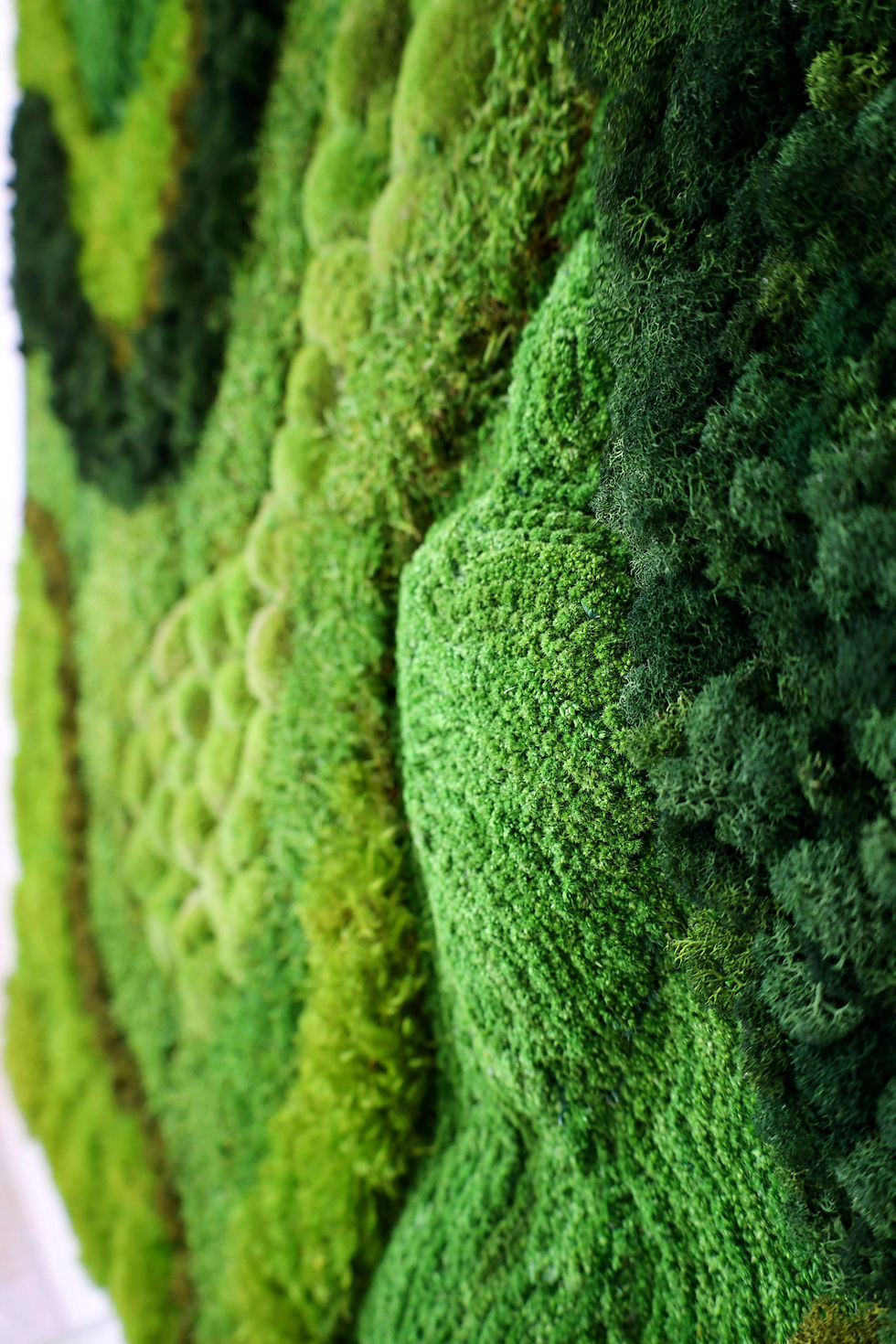
Not at all. Preserved moss is a material, in the same way that paint, clay, wood or textile can be a material. What ultimately distinguishes one work from another is how it is composed and made.
My own practice has developed from early moss compositions into more layered and sculptural work that sits between craft, sculpture and biophilic design. I am particularly interested in texture, organic movement, material intelligence and the way natural elements can alter our experience of an interior.
Because the materials themselves are irregular, no two works can ever be completely identical, even when they belong to the same collection.
A natural connection without the maintenance

For many people, the appeal of preserved moss art is ultimately very simple: it offers a way to bring genuine natural material into an interior without creating another maintenance task.
But I think its value goes further than convenience. The best biophilic spaces are not simply filled with green things. They give us opportunities to notice texture, light, irregularity, pattern and the qualities we instinctively recognise from the natural world.
Moss happens to be an extraordinary material for doing that. Seen from across a room it can read as colour and form; viewed closely, it becomes a miniature landscape of individual clusters, tiny variations and unexpected detail.
That change of scale is part of what continues to fascinate me about working with it.
Thinking about bringing moss art into your space?
Ninfa Studio creates original and limited moss artworks as well as bespoke pieces for homes, workplaces, hospitality and wellness interiors. If you are considering a particular wall or would like something made to suit a specific space, you can explore the current collection or get in touch to discuss a commission.
And if you are simply discovering preserved moss art for the first time, I hope this guide has answered some of the questions that brought you here.


Comments